
Five Dysfunctions of a Team - Vone Lab Signature Programme of team coaching
“In today’s fast-paced environment, the ability to effectively manage, motivate, and retain top talent is the definitive competitive edge.”
There’s no question that the way teams operate, and what motivates them, has changed dramatically. Today, many teams are functioning well below their true potential. The familiar phrase “teamwork makes the dream work” isn’t just a cliché; it’s a reality. In any workplace where people with diverse backgrounds, strengths and perspectives come together around a shared goal.
But what separates a high‑performing team from one that’s struggling?
My signature programme is based on Patrick Lencioni’s renowned framework, Five Dysfunctions of a Team, highlights the key behavioural patterns that determine whether a team thrives or fails.
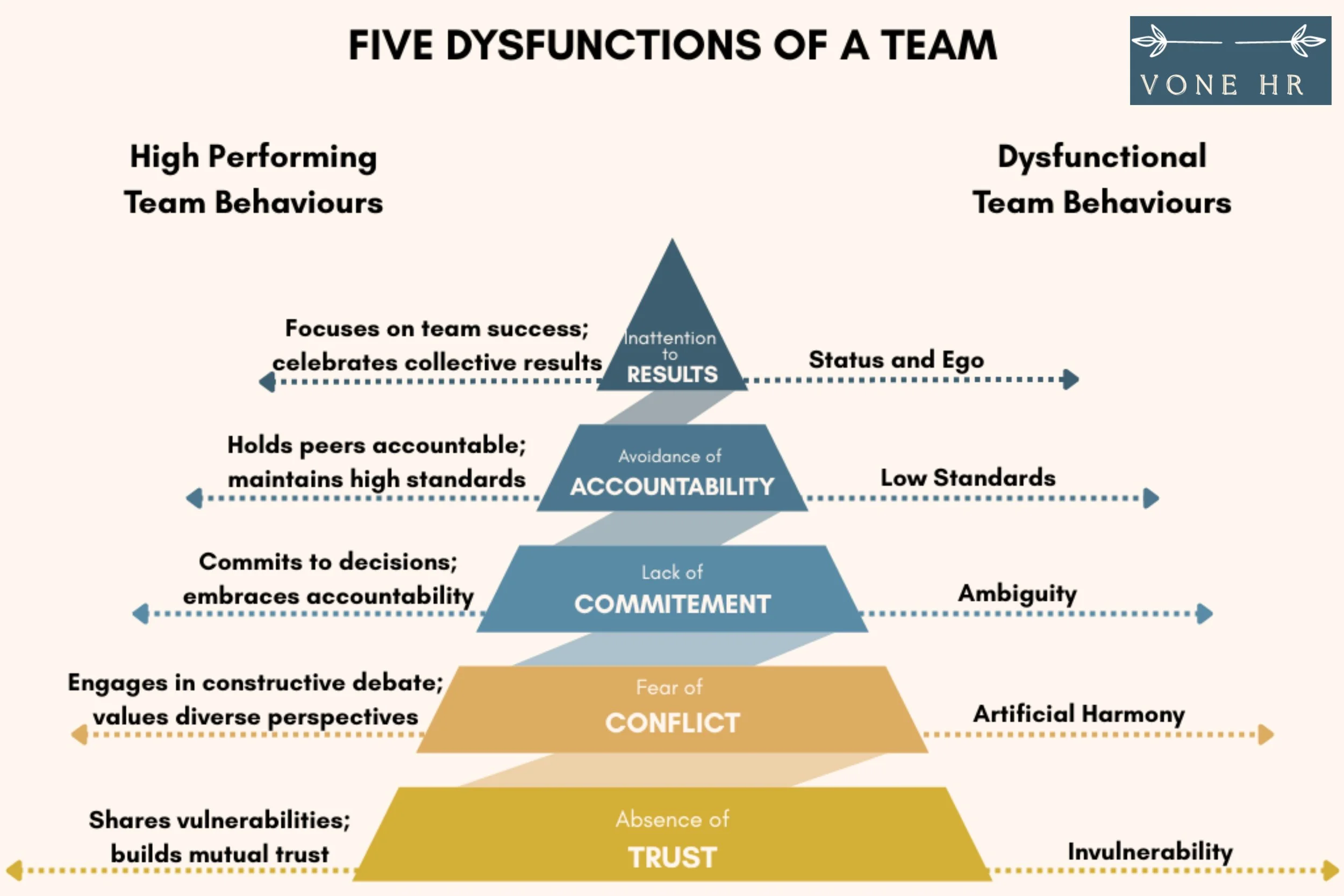
The Five Dysfunctions of a Team
Let’s explore Lencioni’s Five Team Dysfunctions in more detail.
1. Absence of Trust
Trust is the bedrock of any strong team. When trust is missing, people hide mistakes, avoid asking for help, and second‑guess each other’s intentions. A healthy team environment allows members to be open about their challenges, admit when they need support, and view vulnerability as a path to growth, not a weakness.
Questions to help uncover a lack of trust:
Do team members feel safe admitting mistakes, uncertainties and limitations to one another?
Is the team open and transparent in sharing thoughts and ideas, or do people tend to hold back?
Have team members genuinely taken the time to understand each other’s personalities, working styles and strengths?
2. Fear of Conflict
Without trust, teams shy away from healthy conflict. Instead of engaging in productive debate, they avoid difficult conversations and controversial topics. Yet open dialogue is essential for reaching sound decisions and solving complex problems.
Questions to explore fear of conflict:
Are team discussions lively and engaging, or do they feel flat and superficial?
Do members avoid disagreements, or do they embrace them as part of effective decision‑making?
Are decisions made with little debate, or do team members challenge assumptions and push for the best outcomes?
Do problems surface early, or do issues simmer beneath the surface for too long?
3. Lack of Commitment
When teams avoid honest debate, people may feel unheard. As a result, they disengage from decisions and hesitate to fully commit to the direction chosen. This can lead to confusion, hesitation and inconsistent execution.
Questions to identify lack of commitment:
Can team members clearly articulate the team’s priorities and strategy, or is there uncertainty?
Do people understand how their role contributes to the broader mission?
Are responsibilities consistently followed through, or do commitments slip?
4. Avoidance of Accountability
Without commitment, accountability becomes nearly impossible. Team members who aren’t completely bought in are less likely to hold themselves or their colleagues responsible. This leads to missed deadlines, lowered expectations, and inconsistent performance.
Questions to reveal avoidance of accountability:
Do team members expect excellence from one another, or do they overlook poor performance?
Does the team genuinely operate at a high standard, or would a highly driven newcomer stand out?
Are colleagues comfortable asking each other to improve, or do they shy away from those conversations?
As a manager, have I set clear expectations- and are those consistently reinforced?
5. Inattention to Results
When accountability is weak, people often shift their focus from collective success to personal recognition, individual goals or departmental agendas. The team’s shared objectives suffer as a result.
Questions to spot a focus away from results:
Does the team prioritise collective success over individual achievements?
Would team members make a reasonable personal sacrifice for the benefit of the group?
Are decisions driven by what’s best for the team, or by compromises between personal preferences?
Does the team regularly review progress toward shared goals, or is performance mostly evaluated at an individual level?
“To understand the whole, it is necessary to understand the parts. To understand the parts, it is necessary to understand the whole. Such is the circle of understanding.” — Ken Wilber
Case Study – The Challenge with Jamie
Jamie has been a committed member of the organisation for over twenty years and quickly earned a place on the executive team. Known for a strong work ethic and deep alignment with the organisation’s mission, Jamie regularly steps in when others fall short and consistently delivers high‑quality work. However, Jamie’s direct and sometimes abrasive style can create friction with colleagues.
Over the past eighteen months, turnover within Jamie’s department has risen noticeably. After speaking with staff, the CEO has learned that interpersonal tensions may be contributing to the issue. While the CEO values Jamie’s dedication and significant contributions, they also recognise that Jamie may have a blind spot affecting team morale and communication.
The CEO has asked for Jamie alone to receive coaching. While this is a common approach, it often addresses symptoms rather than the underlying group dynamics.
Individual coaching can be helpful, but true improvement usually requires strengthening trust, communication and emotional awareness across the entire team, not just one person.
Many organisations have a “Jamie” - highly skilled and deeply committed, but challenging interpersonally. Meaningful, lasting change comes not from coaching one individual, but from developing the emotional intelligence and relational strength of the whole team.
Looking inward, both as individuals and as a team, is rarely easy. It requires honesty, vulnerability and the willingness to confront habits that may feel deeply familiar. But when a team is ready to rebuild its foundation with trust, healthy conflict and shared accountability, the impact becomes unmistakable. Teams that commit to this work don’t just function better, they think together, decide together and ultimately win together. The results speak for themselves.
Vone HR would love to help you to support you in a deep dive with your team if you are experiencing a current change or a merger with a new team, or simply a team conflict that you are not able to overcome. Get in touch