
Managing Underperformance Under New Employment Legislation: Why Coaching Matters More Than Ever
When an employee’s performance dips, many organisations default to formal processes far too quickly. But with increasing emphasis on fair processes and reasonable support within employment legislation, coaching-led conversations are becoming one of the most effective ways to support improvement.
Here’s why.
Imagine this scenario…
Susan and the unexpected chat with her line manager and HR
Susan is happily sipping her 3 pm tea when a message pops up:
"Hi Susan, could you pop into Meeting Room 4 for a quick chat?"
Instant panic. Everyone knows Meeting Room 4 is where the confidential conversations happen.
As she walks in, HR is already there, smiling warmly. Her manager is smiling too. It’s meant to be reassuring, but somehow it makes the moment even more terrifying. Then the words arrive:
"Susan, we’ve noticed your performance has dipped lately."
Susan is genuinely confused. Just six months ago she received a glowing appraisal. What could have changed? Was it the spreadsheet she sent yesterday titled “FINAL v3 PLEASE WORK.xlsx”?
Out loud, she manages a cautious: "Oh… right. I’m a bit confused."
A few deadlines have slipped
Reports have become slightly… interpretive
Attendance at meetings has been somewhat “creative”
And yes, the spreadsheet name did raise a few eyebrows
The twist
Instead of doom, gloom, or a dramatic exit, HR and her manager simply want to:
Understand what’s happening
Offer support
Help her get back on track
No disciplinary drama. No rocket launch into the sun.
Susan leaves the meeting relieved, slightly sweaty, and determined to resurrect her inner high performer. Whilst the message was positive, what could have been done better in managing Susan’s conversation?
What Susan’s experience tells us about performance management
Performance management is often misunderstood as something that only happens when things go wrong. In reality, it should be a continuous process that helps people stay aligned with organisational goals, feel supported in their development, and maintain strong performance over time. Clarity is key, and I think Susan missed that continuous process and clarity, as the meeting sounded more like a surprise meeting
When underperformance does arise, the objective should not be blame. Instead, it should be an opportunity to understand what has changed, explore the barriers, and work collaboratively towards improvement.
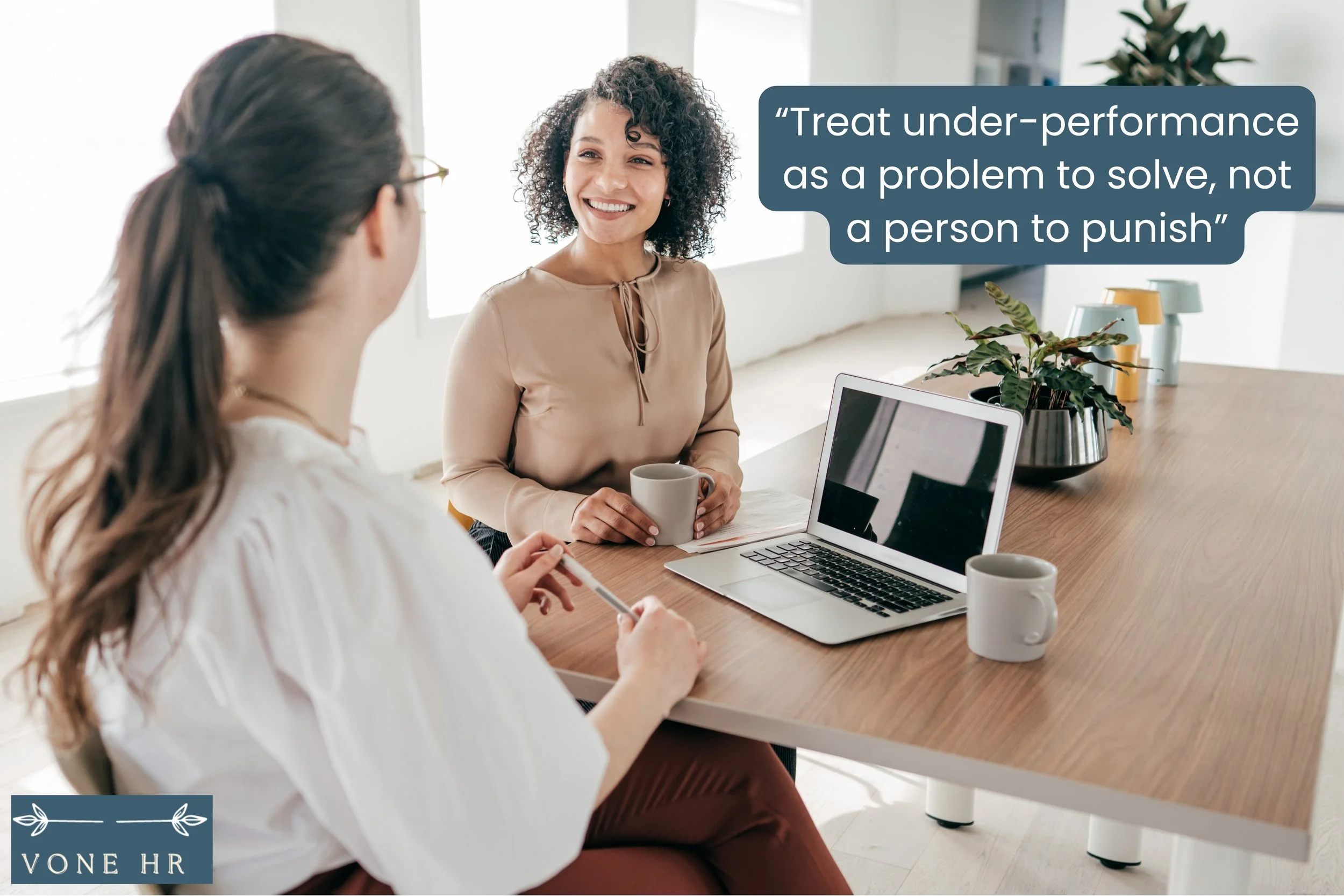
The most effective organisations treat underperformance as a shared problem to solve, not a personal failing to punish.
This approach is becoming even more important as employment legislation increasingly emphasises fair processes, transparency, and reasonable support for employees before formal action is taken.
Why underperformance happens (and why it’s rarely about capability alone)
In most cases, underperformance is a symptom rather than the root problem. Before jumping to conclusions, effective managers explore the wider context. Common contributing factors include:
Clarity gaps
Expectations may be unclear, priorities may have shifted, or feedback may have been inconsistent.
Skill or knowledge gaps
New systems, evolving role requirements, or training needs may be affecting confidence or capability.
Workload or process barriers
Bottlenecks, unrealistic deadlines, or limited resources can quickly impact performance.
Wellbeing factors
Stress, burnout, health concerns, or personal circumstances can all influence someone's ability to perform.
Cultural or relational challenges
Conflict within teams, lack of psychological safety, or poor communication can create barriers to success.
Leadership and management factors
Inconsistent direction, limited support, or unclear standards can also contribute.
A supportive performance culture starts with the assumption of positive intent and a genuine desire to understand what might be getting in the way.
A practical framework for managing underperformance
Organisations that handle underperformance effectively tend to follow a clear and supportive structure.
1. Start with early, informal conversations
The most powerful intervention is often the simplest: a timely, honest, and compassionate conversation.
Addressing concerns early prevents small issues from escalating and helps employees feel supported rather than judged.
2. Diagnose before you prescribe
Before introducing solutions, managers need to understand the situation fully.
This means exploring:
What is working well
Where challenges are appearing
Whether expectations were clear
What barriers may exist outside the employee’s control
In performance conversations, curiosity will always outperform assumptions.
3. Co-create a support plan
If improvement is needed, the next step should be a clear and collaborative plan.
A supportive improvement plan should include:
SMART objectives
Clear success measures
Agreed support such as training, coaching, shadowing, or resources
Regular check-ins to review progress
A realistic timeframe
The tone here matters enormously. The goal should always be developmental rather than punitive.
Coaching as a high-impact performance too
This is where coaching becomes particularly powerful.
Unlike traditional performance management approaches that focus primarily on tasks and outputs, coaching encourages reflection, ownership, and sustainable behavioural change.
One-to-one coaching can help employees:
Build confidence and self-awareness
Identify unhelpful patterns or blockers
Strengthen communication and prioritisation skills
Develop resilience and problem-solving capability
Reconnect with their motivation and purpose
Perhaps most importantly, coaching creates a safe, non-judgmental space for growth and honest conversation.
Monitoring progress fairly
Regular, structured reviews help maintain momentum and prevent surprises.
Managers should:
Recognise and celebrate improvement
Address any remaining gaps with clarity
Keep documentation proportionate and factual
If improvement does not occur despite appropriate support, a more formal process may become necessary.
However, this should only happen after reasonable informal steps and support mechanisms have been explored.
Building a culture that prevents underperformance
The most effective performance management systems are preventative rather than reactive.
They typically include:
Clear expectations from day one
Regular and meaningful feedback
A culture that balances appreciation with accountability
Psychological safety so employees feel able to ask for help early
Leaders who model transparency and fairness
Ongoing monitoring of workload and wellbeing
When people feel supported, trusted, and valued, performance often improves naturally.
Final thought
Performance management isn’t about catching people out.
It’s about lifting people up.
When expectations are clear, conversations happen early, and coaching is part of the process, organisations create an environment where people can recover, improve, and succeed.
And when improvement still doesn’t happen despite genuine support, a fair and structured process ensures decisions are transparent, proportionate, and legally sound.
A useful question for leaders to consider:
If someone in your team began to struggle tomorrow, would your first instinct be to start a process… or to start a conversation?