
The Untouchables: How Toxic Leaders Keep Winning
Last month, I wrote about Susan and the unexpected conversation she found herself in with her line manager and HR. The conversation was framed as “performance management.” But it was delivered without clarity or structured support.
I explored how performance management is so often misunderstood as something that only happens when things go wrong. It should be a structured, compassionate process that helps us understand what has changed, identify barriers, and work collaboratively towards improvement. The most effective organisations treat underperformance as a shared problem to solve, not a personal failing.
Reflecting on that story this month, I’ve been thinking about what happens when this mindset is absent, not just in isolated cases, but as part of a wider culture. Because when a leader’s default, is to blame, avoid accountability, avoid honest conversations, or use processes as a shield rather than a support, it’s rarely about one difficult manager! It’s usually a sign of a culture that quietly enables toxic leadership.
It’s often a symptom of something deeper: a culture that enables toxic leadership to thrive. Every so often, someone asks me, “How does that Senior Leader still have a job?” It’s a fair question. We’ve all seen it, the leader who drains morale, the director who rules by fear, the CEO who talks about “culture” while quietly eroding it. Yet somehow, they stay. They even get promoted.
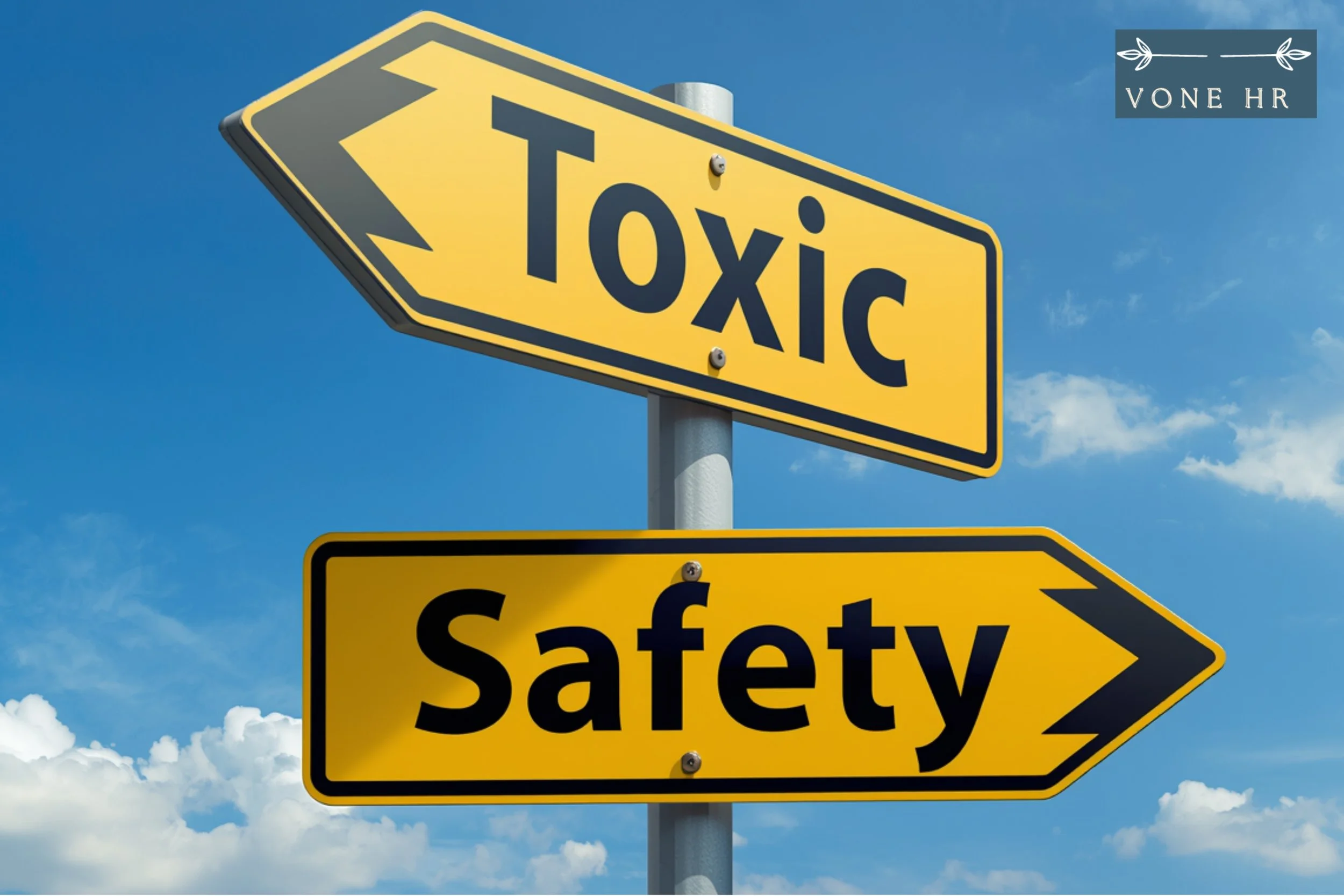
Toxic leaders don’t thrive because they’re talented. They thrive because the system around them allows, and sometimes rewards, the very behaviours that undermine trust, psychological safety, and performance.
When accountability is inconsistent, when poor behaviour is overlooked because someone else in the team delivers results, or when speaking up feels risky, toxicity doesn’t just survive. It embeds itself.
It’s maddening, but it’s not mysterious. So, let’s break this down:
1) Toxicity often hides behind performance metrics
Toxic leaders deliver results on paper. They hit targets, cut costs, or drive output in ways that look impressive to senior leadership. What doesn’t show up in the spreadsheet is the trail of burnout, turnover, and psychological harm left behind.
When organisations reward outcomes without examining how those outcomes were achieved, toxicity becomes invisible or worse, rewarded.
2) People in power protect people like them
It’s an uncomfortable truth to hear, but in my experience, toxic leaders often survive because they are connected, familiar, or politically useful. They know how to “manage up,” charm the right people, and frame their behaviour as “strong leadership” rather than what it is - intimidation, manipulation, or neglect.
When the people evaluating them don’t feel the impact of their behaviour, accountability for them becomes optional.
3) Employees are afraid to speak up
Most people don’t report toxic behaviour because they’ve seen what happens to those who do. They get labelled “difficult,” “emotional,” or “not a team player.” They get sidelined, scrutinised, or quietly pushed out. The price of silence is organisational suicide, innovation slows, and morale sinks. The best talent often leaves the very people who had the courage to tell the truth. What’s left is a culture of fear, where staying quiet becomes the only survival strategy. In these environments, employees stay loyal to their salary, not the mission.
4) HR is often positioned as risk-management, not culture-care
This one is painful for me to write, because I know how many HR professionals genuinely want to help. But in many organisations, HR is structurally designed to protect the organisation first, not the employee. That means toxic leaders, especially high‑performing ones, are treated as “risks to be managed,” not problems to be solved.
Until HR is empowered to act as a culture steward rather than a corporate shield, toxic behaviour will continue to slip through the cracks.
5) Organisations rarely measure the real cost of toxic leadership
Turnover, disengagement, absenteeism, presenteeism, reputational damage is expensive. But because they’re diffuse and long‑term, they’re rarely traced back to the leader who caused them.
If organisations calculated the financial impact of toxic leadership, many “untouchable” managers would suddenly become very dispensable. How do you do that? Start looking at exit interview themes, engagement survey data, grievance patterns, team‑level performance trends, absence patterns, and 360 feedback. If the same leader’s name appears repeatedly, the attribution becomes clear.
6) Ending toxic leadership starts with changing the system, not the people
The encouraging reality is that these dynamics can change through a relentless education in the workplace. Understanding why toxic employers remain in place isn’t about blame, it’s about recognising the structural, cultural, and behavioural patterns that allow harmful leadership to persist. When organisations fail to examine these patterns, they unintentionally reinforce them.
Organisations that invest in transparent processes, psychologically safe reporting mechanisms, leadership development, and evidence-based HR practices create environments where accountability becomes the norm rather than the exception.
Toxicity recedes when organisations commit to:
Evaluating leaders on both outcomes and behaviours
Listening to employee experience data with genuine curiosity
Empowering HR to act as a strategic partner
Introducing team coaching
A recent example from my own practice, was a leadership team who was struggling with mistrust, siloed decision‑making, and rising turnover. The CEO came to me and agreed to begin a team‑coaching programme.
Instead of focusing on individual performance, we worked on how they operated together, how they communicated under pressure, how they managed disagreement, and how they made space for challenge without defensiveness.
Over time, the team began to recognise the patterns that were fuelling frustration, the interruptions, the avoidance, the last‑minute escalations, and they started to experiment with new ways of working.
What changed wasn’t just behaviour. Leaders felt more comfortable to speak honestly, and to enter healthy conflicts. Leaders became more aware of their impact, and accountability shifted from “who’s to blame” to what do we need to do differently as a team?
Ultimately, overcoming toxic leadership isn’t about removing a few difficult individuals. It’s about reshaping the conditions that allow those behaviours to take root in the first place. When organisations invest in team coaching, build psychological safety, and hold leaders accountable for how they lead as much as what they deliver, the culture begins to shift. Toxicity doesn’t disappear overnight, but it becomes harder to hide and harder to justify. That’s how real change happens. Not through one-off interventions, but through a sustained commitment to continuous building workplaces where healthy leadership is the norm, not the exception.
Read More: “Managing Underperformance Under New Employment Legislation: Why Coaching Matters More Than Ever”